
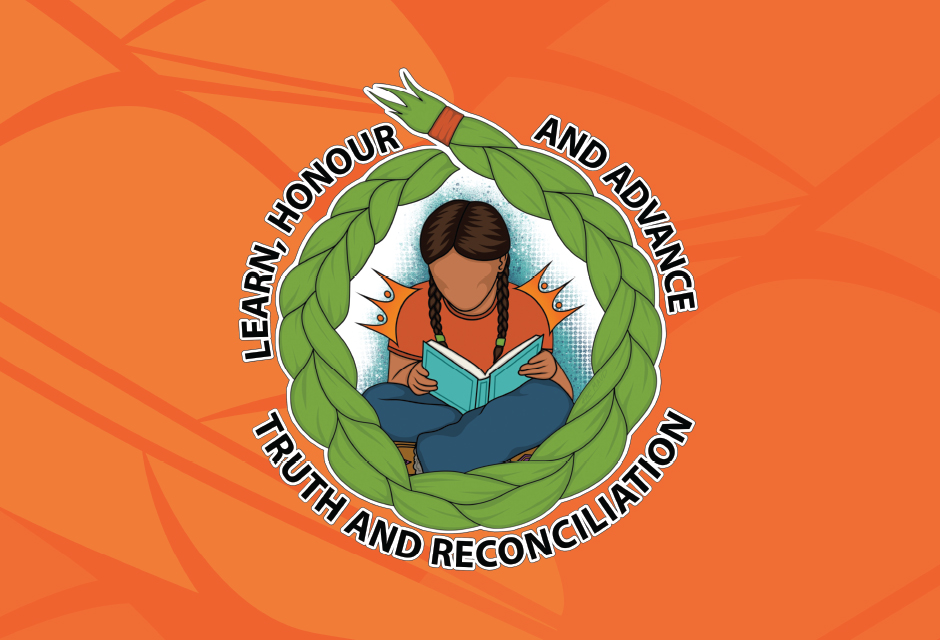
The Manitoba Teachers’ Society is proud to introduce a new Orange Shirt Day design created by Kae Maud. Kae, artist name ‘Skultural,’ is an Indigenous Two-Spirit artist from Swan Lake First Nation whose work celebrates culture, identity and community through painting, digital design and murals.
For this design, Kae drew on both Indigenous teachings and the importance of education. At the centre is sweetgrass, which is one of four medicines alongside tobacco, sage, and cedar, braided around a child who is reading. The imagery reflects the belief that knowledge is sacred and so are children.
Adding to The Society’s colour palette, the design serves as a reminder of the role education can play in truth, healing and reconciliation.
Kae’s journey as an artist has also led them to begin teaching art to youth and collaborating with organizations on educational projects, which is especially meaningful.
“Designing shirts is a passion of mine, and it brings me joy to see my students and others wearing them.”
Learn more about Kae Maud and view their designs here.
The Orange Shirt Day Legacy
Orange Shirt Day – Every Child Matters is a legacy of the St. Joseph Mission Residential School (1891-1981) Commemoration Project and Reunion events that took place in Williams Lake, BC, in May 2013. This project was the vision of Esketemc (Alkali Lake) Chief Fred Robbins, who is a former student himself.
Following the commemoration event, former student Phyllis (Jack) Webstad shared her story of her first day at residential school when her shiny new orange shirt, bought by her grandmother, was taken from her as a six-year-old girl.
Her bright orange shirt symbolized love, excitement, and belonging. When it was taken away, it represented how the system tried to strip away identity, culture, and the fundamental truth that Every Child Matters.
September 30 was chosen for Orange Shirt Day because it is the time of year in which children were taken from their homes and their families to Indian residential schools, and because it is an opportunity to set the stage for anti-racism and anti-bullying policies for the coming school year.
Learn more about Phyllis’ story in her own words here.