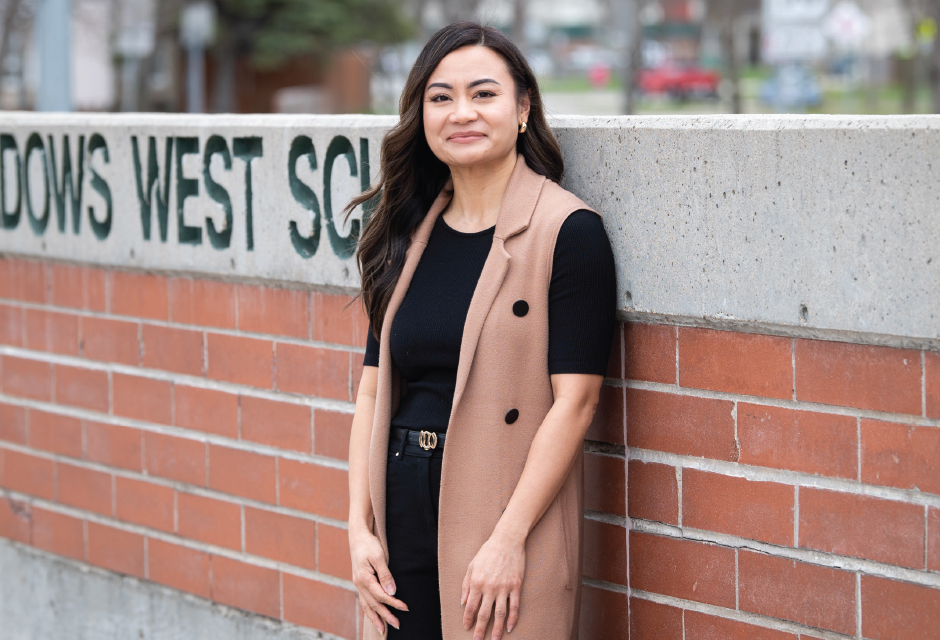
Jacqueline Tabios believes culture belongs in the classroom every day.
The Meadows West School learning support teacher has spent 21 years with the Winnipeg School Division creating spaces where students feel “seen, heard and valued,” while helping them celebrate their identities and learn from one another.
As a Filipino Canadian educator, Tabios said that growing up, she only had one Filipino teacher. That teacher also introduced students to cultures from around the world through multicultural events and dance performances.
“Having her as my teacher provided me with a powerful sense of being represented and a feeling of belonging,” she said. “When students see their cultures, identities, languages, and experiences reflected in teachers, books, and lessons, it affirms that they matter.”
Today, she brings those same values into her classroom by building relationships and encouraging students to share their identities, languages and lived experiences. “It is through these relationships that students are able to bring their authentic selves into the classroom,” she said. “And as an educator, it is for me to recognize opportunities to share those experiences.”
One of those opportunities was reading the book Cora Cooks Pancit by Dorina Lazo Gilmore, about a Filipino girl who gets to cook pancit with her mom, using her grandma’s recipe. The story sparked discussions about food, family and cultural traditions.
Students shared recipes, wrote poems and celebrated with a multicultural potluck where families contributed dishes from home. “You can feel the excitement when they see similarities between the different cultural foods. A student from Syria was excited to discover that the food they eat is similar to food Filipinos and Spanish eat. It’s not just about food…. it’s about the stories they tell that are hidden gems.”
Meadows West School has a large Filipino student population and offers a Filipino Bilingual Program. One of the school’s largest cultural celebrations is its Philippine Independence Day assembly, held each spring. Tabios said the idea began when she noticed students struggling to share their cultural history during a heritage project.
“I noticed that the Filipino students could not share much about their cultural history,” she said.
“And when I did my own reflecting, this was something I realized too. I’m a first-generation Canadian, just like my students.”
That realization inspired Tabios and her colleagues to learn alongside their students.
“We wanted to create opportunities for students to learn more about their cultural identity,” she said.
While preparing for the event, students explore topics that interest them, including Filipino history, language, folklore, music and dance. Families and staff also take part in performances and presentations.
“One of the best parts of the assembly is seeing the families’ sense of pride, belonging and validation,” Tabios said. “For many, it is like bringing them back home to the Philippines.”
She added that the goal is not only celebration, but connection.
“Students just want to belong and connect, and by having representations of different cultures, it creates empathy and understanding, where students learn about different perspectives,” she said.
“It is a reminder that all cultures are equally valuable. We are all contributing to the rich diversity here at Meadows West.”