
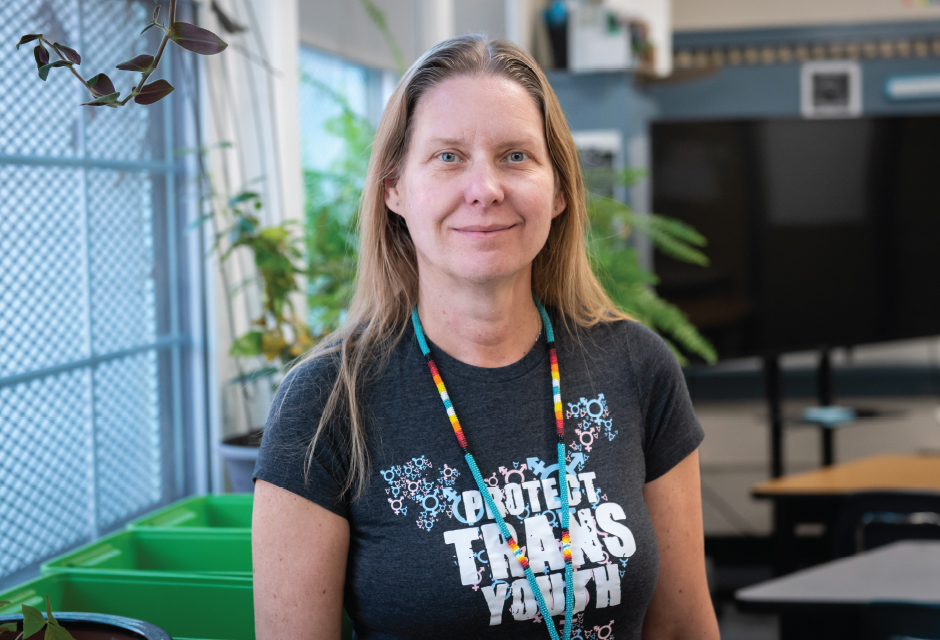
Inside the Student-Driven GSA at École River Heights School
Jennifer Wiebe, a Language & Literature and Truth and Reconciliation educator at École River Heights School, has long been committed to fostering equity and belonging in her classroom and beyond. A recipient of the Prime Minister’s Award for Teaching Excellence, Wiebe has been instrumental in shaping the school’s inclusive practices, including the development of one of Winnipeg’s first middle years Gender Sexuality Alliance (GSA) clubs.
The GSA at École River Heights began in the 2015-2016 school year, sparked by a student request at a time when GSAs were still largely found only in high schools. Wiebe and colleague Petra Thanisch had already been running the ‘Butterfly Effect Club’ which focused on human rights, and it quickly became clear that 2SLGBTQIA+ students needed a dedicated space of their own. “The first openly trans student I encountered in middle school came up to me and said, ‘We need a GSA,’” Wiebe recalls. “Once a student asks, we are obligated to make it happen and we were happy to.”
That first meeting drew nearly 50 students – standing room only. Their needs were diverse, so the club grew into two branches: an activist group focused on educating peers, surveying the school community, and advocating for changes such as the school’s first universal washroom; and a quieter, safe-space group centered on connection, crafts, and conversation. “There was a lot of emotion, almost like a group therapy session at times,” Wiebe says. “And I’m not a counselor; I’m a classroom teacher. So, it almost felt, at times, like we were maybe a bit out of our element. We did start inviting guidance to join us as much as possible.”
Today, the club continues to evolve based on student voice. Participation shifts year to year, and Wiebe sees that as a sign of success, not decline. “I think sometimes there’s this idea that every kid who identifies as queer is attending the GSA every week which is not the case,” says Wiebe. “And the years that we run the musical, for example, the theater almost becomes the de-facto GSA in a different way. Because of the culture of this school, and in particular this division, kids can feel safe in a variety of spaces.”
The GSA now meets once a week, welcoming students from Grades 7 and 8, with a strong emphasis on flexibility: no registration, no attendance pressure, no requirement to disclose identities. “We always say anyone can come. We don’t check identity cards.”
Visibility and celebration remain central. Over the years, the club has marched in Winnipeg’s Pride Parade, taken charge of the International Day of Pink school assembly, organized bake sales and rainbow potlucks, raised money for charity, partnered with Kelvin High School’s GSA, and taken part in community events and reading programs in feeder schools. The club maintains an ever-changing bulletin board that reflects the topics they’re focusing on, such as features on rainbow books in the school library. They even launched their own neighbourhood Pride walk last year – complete with bubbles, music, and cheering elementary students lining the fences.
Wiebe is proud not only of the club’s accomplishments, but of the relationships built within it. Students who might struggle in the classroom often find comfort and confidence in the GSA. Newcomer students, including those whose families fled persecution for their identities, bring perspectives that deepen discussions and empathy. “For some kids, when they’re in the classroom, maybe that’s not their most successful space. The GSA is a place where those kids can really come out of their shell and be themselves.”
After nearly a decade, Wiebe’s philosophy remains simple: a GSA must be student-driven. “It doesn’t need to be big or impressive,” she says. “As long as it responds to the needs in the room and keeps students at the center, it will always be what it needs to be.”
Her students agree. As one Grade 7 member shared, “Our GSA is important to me because it helps me feel confident in myself… I learn more about who I am and who I want to be.”
Wiebe says she’s happy to talk to teachers if they have questions about starting their own GSA, especially those in rural areas, but the request for the club should come from students, based on their own comfort. She acknowledges that there can be quite a difference between city schools and rural schools. “It’s important for our kids to know what we have here at River Heights. We know that we can put a rainbow flag in my class and march around the neighborhood, and nobody’s going to be calling and complaining. That is a privilege.”