
In classrooms across Manitoba, a new challenge has emerged, one that simply didn’t exist a generation ago. Students are surrounded by information but often do not recognize where it comes from. Much of their “news” comes by way of social media, videos, memes, and AI-generated content. For most students, local newspapers aren’t part of daily life, and the importance of good journalism, is unclear.
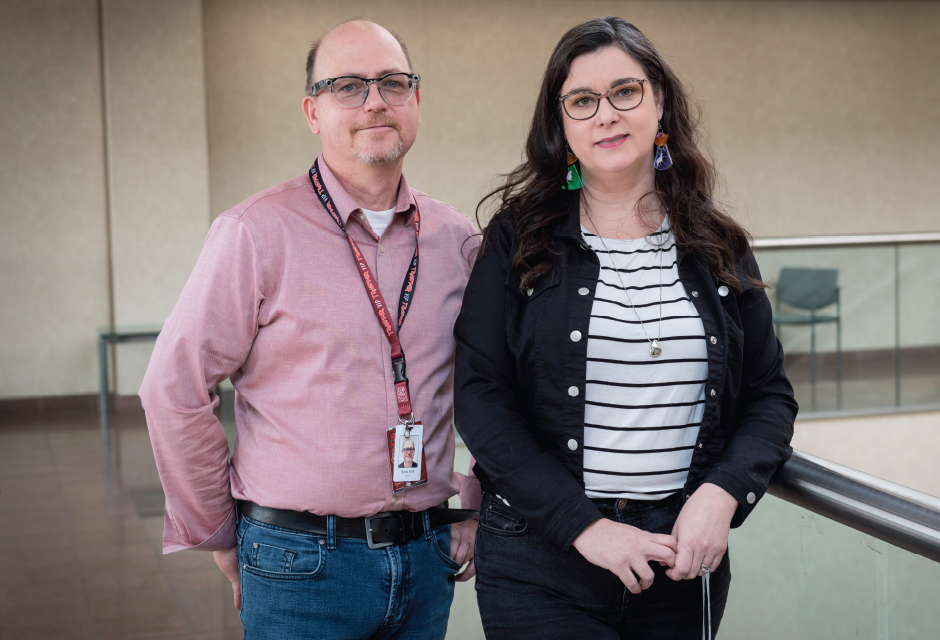
This new reality is what brought together teachers Rebecca Chambers and David Wall. Working alongside the Government of Manitoba, the Winnipeg School Division, and the Winnipeg Free Press, they are leading the Winnipeg Free Press Media Literacy and Learning Project, a collaboration designed to build media literacy across all grades and subject areas.
Teachers First
Rebecca Chambers is a human ecology, drama and social studies teacher at Shaftesbury High School and works as a freelance columnist with the Winnipeg Free Press. Chambers is now on interchange with the Province of Manitoba to co-lead the Media Literacy Project.
“It was in discussions with Paul Samyn, the editor of the Winnipeg Free Press, that we started hatching a plan for collaborating, and understanding that democracy, government, education, and media should all be pulling in the same direction,” Chambers explains.
David Wall previously worked as a Coordinator and STEM/STEAM and ICT Consultant. Before that, he taught film and journalism in Pembina Trails.
“Ninety percent of literacy with ICT is media literacy,” he says, explaining that the competencies, skills, and outcomes are all the same. “Students are going to come out with those competencies and grow with the sets of skills that are going to really help them survive in an AI-influenced world.”
Today, both he and Chambers are on two-year contracts with the project. The Free Press is providing staffing, staff support, web design, and web development support. “It’s been designed to live on beyond when our terms are up,” says Chambers. “We’re here doing the heavy lifting, and getting everything going, and then it’s been designed in a way that maintaining it doesn’t exceed the capacity of the Free Press.”
The Project
The Media Literacy and Learning Project is a free resource, designed for teachers of all grades, with an awareness of workload, time constraints, and the need for flexibility.
The “Student Press” and “Free Press 101” sections are already live. The “Student Press” section supports student journalism at all grade levels and includes startup guides, learning experiences, and a growing “newsstand” where student publications from across Manitoba are shared.
The papers range from high school to early years projects, including a Grade 1-2 alphabet newspaper created by students from Gladstone who went around their community photographing alphabet related objects.
“Little kids have stories to tell,” Chambers says. “This isn’t just a high school project.”
The “Free Press 101” section showcases how journalism works. Through articles and teaching resources, students learn how stories are pitched, reported, edited, and published, and how the Free Press ensures accuracy, integrity, and accountability.
Teacher Resources Coming Soon
The second part of the project is “Resource Bundles”, set to launch by Spring 2026. These customizable multimedia lesson plans will allow teachers to build lessons around media literacy concepts using curriculum-specific Free Press articles. Teachers will be able to focus on different curriculum areas, adjust reading levels, translate content, add accessibility features like text-to-speech or dyslexic-friendly fonts, and tailor materials for diverse learners.
Beyond classroom resources, the project also opens doors to real-world learning. Schools can book field trips to the Free Press newsroom, where students tour creative services, meet journalists, and watch the printing presses in action – something that kids find very exciting according to Wall.
Why It Matters
Teachers have repeatedly told Chambers and Wall the same thing – this work feels urgent.
“Everyone can see what’s happening internationally and nationally,” Wall says. “And they connect it directly to their classrooms.” Wall says teachers have told them that a lot of students have never seen a newspaper or had one delivered to their home. “It’s been kind of huge learning and recognizing that we know what newspapers are but there’s an entire generation that don’t.”
The project’s impact is reaching beyond Manitoba, even catching the attention of the New York Times Learning Network.
Chambers says the project’s real success lies in helping young people recognize that their voices matter, and that the media they create can strengthen their schools, communities, and the province as a whole.