
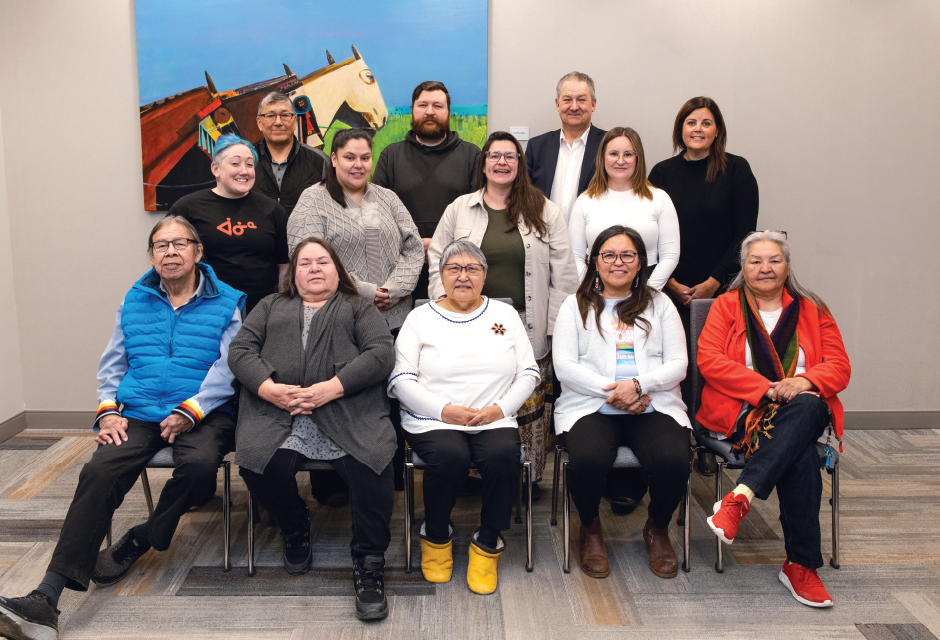
Circle of Indigenous Elders bottom row pictured from left to right: Don Robinson, Connie West-Buck, Tagaaq (Maata) Evaluardjuk-Palmer, Virginia Birch, and Chickadee Richard
Second row from left to right: Lindsay Brown (PX), Tobi Wilson, Judy Saunders-McKay, Amber Brown
Top row from left to right: Circle of Indigenous Elders member, Mervin Mckay, Reid Bouvier, Réjean LaRoche (staff), and Tracy Vanstone (staff)
Not pictured: E. Manny Skead, Jennifer Alcock, and Ashly Dyck
Circle of Indigenous Elders
For many years, Indigenous Elders and Knowledge Holders have contributed to the work of The Society through relationships built on trust, respect, and shared purpose. These collaborations, often informal and project-based, were made possible through connections fostered by individual members and Society staff. While meaningful, these engagements were not embedded within the formal structure of The Society.
Over time, a growing recognition emerged: to truly honour Indigenous perspectives and advance meaningful reconciliation, this guidance must be sustained, supported, and structurally integrated within The Society.
In the past decade, The Society has taken important steps towards this goal, guided by three key priorities:
- Formally recognize the importance of, and need for, guidance from Elders and Knowledge Holders in decision-making and planning at The Society,
- Establish an ongoing group within the formal structure of The Society, recognizing their role in shaping the future of The Society and the public education system in Manitoba, and
- Allocate appropriate resources so that Elders and Knowledge Holders can meet regularly and be compensated for their time, knowledge, and emotional labour that this ongoing work requires.
In 2022, members of the Indigenous Voice and Action Standing Committee brought this vision forward through a resolution for consideration at Provincial Council. This resolution called for the creation of a Circle of Indigenous Educators, Elders, and Knowledge Keepers, to help guide The Society’s work.
Grounded in the Truth and Reconciliation Commission’s Calls to Action, the resolution acknowledged the need for greater Indigenous representation and leadership within The Society. It also recognized the importance of examining existing structures through an anti-colonial and anti-oppressive lens. Establishing a Circle was identified as an act of humility and accountability, an opportunity to listen, learn, and be guided by those whose knowledge systems and lived experiences are essential to shaping a more inclusive and responsive education system.
The resolution passed, marking a significant milestone in The Society’s ongoing journey towards truth and reconciliation. A committee of seven members were appointed by the Provincial Executive to undertake the foundational work required to move forward in a respectful and culturally appropriate way.
Over the course of a year, this group engaged in a learning process that emphasized the importance of relationship building, reflection, and a commitment to proceeding “in a good way.”
In spring 2026, this work came to fruition as six Elders and Knowledge Holders accepted an invitation to join The Society on this journey. The inaugural gathering of the Circle was held on March 27, 2026, marking the beginning of an ongoing relationship grounded in respect, guidance, sustainable action, and a commitment to ensuring Indigenous voices are present and valued in shaping the future of public education in Manitoba.