
When Suzanne Simpson takes her students outdoors, she takes time to introduce them to neighbours they never knew they had.
“This is an elm tree,” she tells them, “and it’s also called aniib—orme in French—and this is how you recognize it by these cool little seeds.”
This connection with nature is at the heart of everything Simpson does as a teacher librarian at École Varennes and École Provencher in the Louis Riel School Division.
“It’s the importance of being able to know something by its name. This is a neighbor that’s part of the world around you. And as much as it’s caring for us, we must care for it too.”
Simpson was recently named a runner-up for the Susan Langley Earth Steward Teaching Award aimed at Canadian educators engaged in environmental education. It is a well-deserved recognition for the work she is passionate about bringing to students.
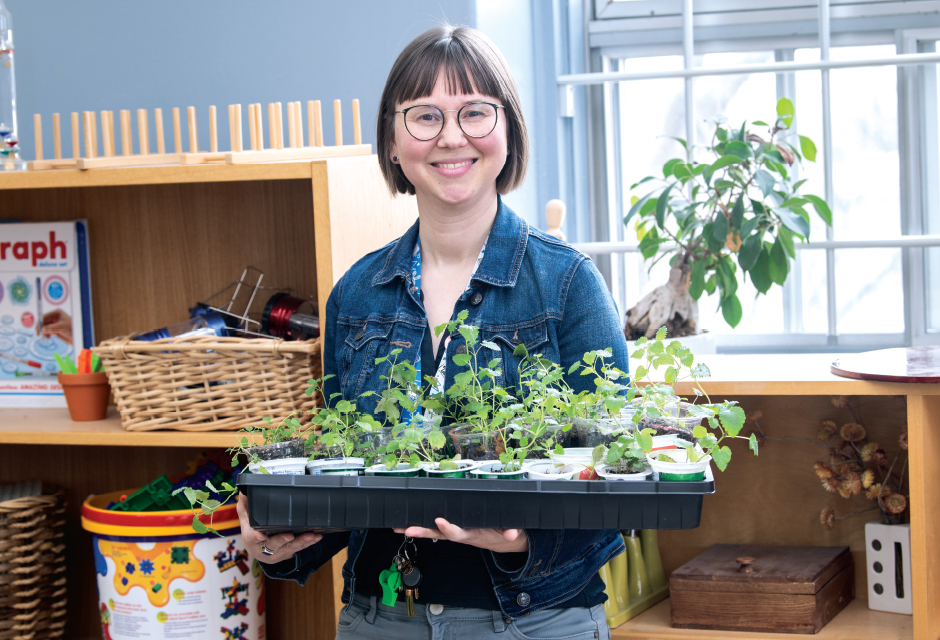
She has started environmental clubs at both schools, where students care for vermi composters, grow herbs and vegetables, and collect food scraps from around school to compost. She runs the school community gardens, brings in guest speakers to present sustainability workshops, and collaborates with classroom teachers on inquiry projects like tapping maple trees and planting seedlings.
“We focus on the action piece,” Simpson said. “What can we do in our community and in our school to make a positive difference?”
Simpson noticed that students had questions and concerns and were very engaged when it came to topics around the environment. She does not shy away from discussing difficult topics like climate change but listens to students on how they feel called to action and then tries to reduce barriers for them.
Building Community
During the summer, families take turns watering the gardens. On Monday evenings, a gardening drop-in at Varennes brings neighbours together to weed, water, and harvest. Extra produce is brought home to be eaten or donated. Despite being a Master Gardener and Master Composter, Simpson said she is always learning from others. “A lot of people are very knowledgeable.”
Simpson is also proud of the work being done by the Educators for Climate Action of Manitoba (ECAM) group which she helped found three years ago. “It was just a bunch of us that were a little surprised that this group didn’t exist already, so we thought, well, we’ll just make one for ourselves.”
The group is committed to advancing urgent climate action and environmental education in Manitoba schools, building community among educators already doing this work and offering quality professional development (PD) on environmental education and climate action. Their PD sessions have covered planning an environmental week around Earth Day, running a bike-bus, and addressing climate anxiety with students. They welcome new members through their website, social media, and newsletter.
Simpson said that the urgency around environment and climate action is real and that last year Manitoba lost roughly eight per cent (8%) of its forests to wildfires.
“This is the most important issue. It’s the biggest crisis humanity has ever faced. Students are looking to the adults in their lives for guidance and they want to see that we’re taking it seriously. They want to see action, and they want to see hope.”
Connect with Educators for Climate Action Manitoba here.